Physical Address
304 North Cardinal St.
Dorchester Center, MA 02124
Physical Address
304 North Cardinal St.
Dorchester Center, MA 02124
Ethereum is a general-purpose Layer-1 Blockchain that serves as the backbone of DeFi.
Ethereum is a general-purpose Layer-1 Blockchain that serves as the backbone of DeFi. Launched in 2015 by Vitalik Buterin, Charles Hoskinson, and their team, the Ethereum Blockchain was the first to support on-chain smart contracts, which allow users to automate tasks such as Auctioning, Lending, Borrowing, Creating Tokens, Launching dApps, and many other activities.
Ethereum was launched in 2015 by Vitalik Buterin, who sought to bring programmability to the Bitcoin Blockchain, which was only able to send and receive cryptocurrencies. The introduction of Ethereum aimed to bring automation, programmability (via Smart Contracts), and decentralized applications (dApps).
Among the co-founders was Charles Hoskinson, who later co-founded another major Blockchain network, Cardano.
Ethereum was the first Blockchain to support complete decentralized financial activities, such as lending, borrowing, staking, token swaps, and bridging. This brought significant functionality to the world of Blockchain, which had previously been limited to just token transfers.
Ethereum has been managed by the Ethereum DAO since its early years, a decentralized organization whose decisions are taken democratically via on-chain voting.
Ethereum suffered a hack in 2016, resulting in the loss of 3.6 million ETH (valued then at $50 million) due to a “recursive call vulnerability”.
The loss was substantial, considering Ethereum’s market cap was $1.2 billion at the time.
As a result, the DAO made a decision to reverse and nullify all transactions just prior to the hack.
This left the entire ETH community in a split, many of whom did not want the reversal, leading to the first hard fork in Ethereum. This hard fork created the Ethereum Classic blockchain.
NFTs are unique tokens used to represent assets such as art, tickets, passes, governance rights, and even property ownership. These tokens were first minted on the Ethereum blockchain and later spread to other chains. Opposed to crypto tokens that were identical to each other, each NFT represented something unique.
NFTs became popular around the 2017-18 crypto bull run, and at their peak were a multi-hundred-billion-dollar market. However, their use declined because they offered only a limited number of applications.
By the 2022 crypto bear market, NFT markets were practically dead.
The Merge was a code upgrade in Ethereum that changed its consensus mechanism from Proof of Work to Proof of Stake, resulting in a 99% decrease in energy consumption.
Further, it also made Ethereum further upgradeable, which was necessary for its scaling. Most decentralized proof-of-work chains, like Bitcoin, are limited to around 7 to 15 transactions per second.
The Dencun Upgrade added a feature on Ethereum blocks called “Blobs”, which are temporary spaces on the blocks where rollup transactions are stored.
In Rollups, multiple transactions are combined into a single batch, which is processed as a single transaction, resulting in much lower gas consumption.
A result of the upgrade was that gas costs became a lot cheaper. Till then (i.e., March 13, 2024), most high gas consumers (layer-2s, layer-3s, stablecoins, and defi protocols), which used the Ethereum L1 chain and jammed up the network. As a result, the gas cost drove up when retail customers tried to use Ethereum. As these “gas guzzlers” began using “blobs”, Ethereum’s L1 chain was freed, making it cheaper (from $150 to $400 per transaction to less than $1 within a year).
Pectra, short for Prague and Electra, was a batch of 11 upgrades that solved several of Ethereum’s scalability and decentralization problems.
In the future, the goal of the Ethereum community remains to onboard light nodes where validators could join Ethereum with just 1 ETH at stake, opposed to the current requirement of 32 ETH.
Further, Sharding of Ethereum’s chain also remains a major goal. Currently, Ethereum has around 1 million validators, which can be easily split into smaller groups, each capable of adding a block to the Ethereum Blockchain.
Vitalik Buterin, the founder of Ethereum, shared his vision that in the future, validator nodes would be so light that they could run on mobile phones.
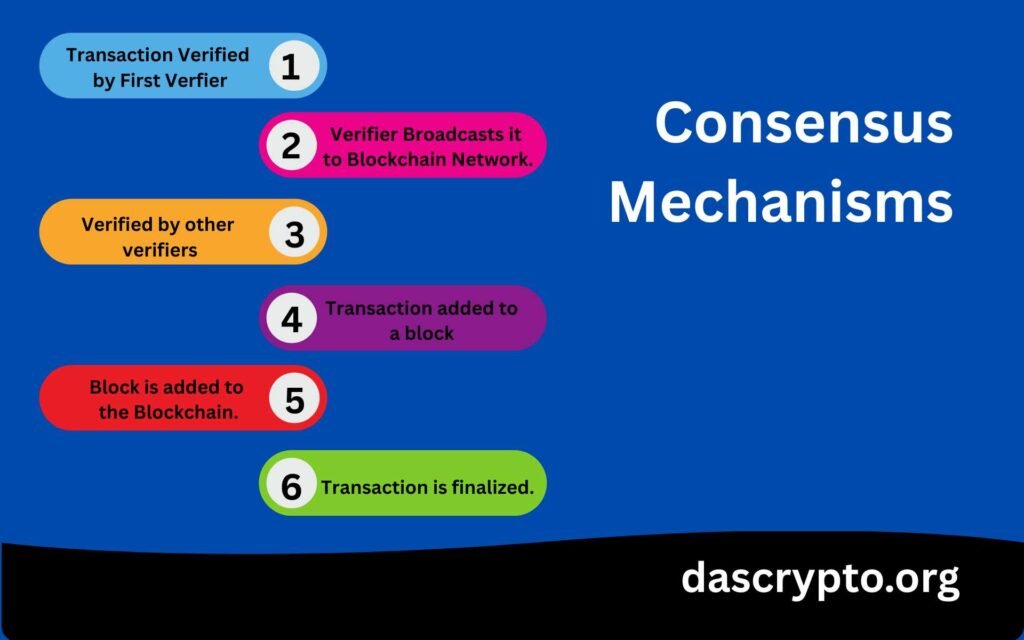
Basically, Ethereum works in 6 stages:
All the processing that makes this possible is done by the nodes, which are computers run by validators. All this processing is done on the Ethereum Virtual Machine, which pulls computational power from its nodes and runs the Ethereum Blockchain.
Ethereum, like all blockchains, uses a consensus mechanism to ensure that each transaction is validated multiple times and that all validators reach consensus before it is added to the Ethereum Blockchain. This is to ensure that trust is attained at the highest level in an otherwise trustless decentralized environment.
Initially, Ethereum used a Proof of Work consensus mechanism that relied on rigorous computational work by validator nodes (computers) to find the same random number (called a Nonce) for a given transaction.
However, this process consumed a lot of energy and required specialized high-powered computers. As a result, Ethereum switched to Proof of Stake in 2022 via a process named The Merge. This made Ethereum a more energy-efficient chain, reducing the energy required to run it by 99%.
Ethereum Classic (ETC) is the version of Ethereum created after its hard fork when the community was split between reversing the DAO Hack and continuing the blockchain to protect its sanctity.
Ethereum Proof of Work (ETHPOW) is a cryptocurrency created after hard-forking Ethereum during the Merge Upgrade, when a certain number of Ethereum community members were against the adoption of the new Proof of Stake consensus.
Layer 0 is the foundational architecture of any Blockchain and comprises the software and protocols that run it. In the case of Ethereum, the layer zero is the Ethereum Virtual Machine.
Example – EVM, Cosmos SDK
Layer-1 is the independent Blockchain that processes and finalizes its own transactions and does not require any external computational assistance. Each Layer-1 has its own or shares a virtual machine with other chains. For example, the Ethereum Virtual Machine originally belongs to the Ethereum Blockchain ( a Layer-1 chain) but is also used by most Layer-2 chains.
Example – Ethereum, Bitcoin, Algorand, XRPL
Layer-2 chains are dependent blockchains that rely on layer-1 chains to finalize their transactions. These chains are often built with speed in mind and therefore have lower security, which necessitates using a Layer-1 chain to finalize their transactions.
Example – Arbitrum, Optimism, Polygon, Linea, etc.
Layer-3 networks are specialized decentralized applications that run on multiple similar chains. Opposed to layer-1 and layer-2, they are not blockchains, but rather networks.
Example – Uniswap
Das Crypto publishes information for knowledge. Please consult your financial advisor before trading or making any investment decisions. Cryptocurrencies are subject to uncertainties and market volatility.