Physical Address
304 North Cardinal St.
Dorchester Center, MA 02124
Physical Address
304 North Cardinal St.
Dorchester Center, MA 02124
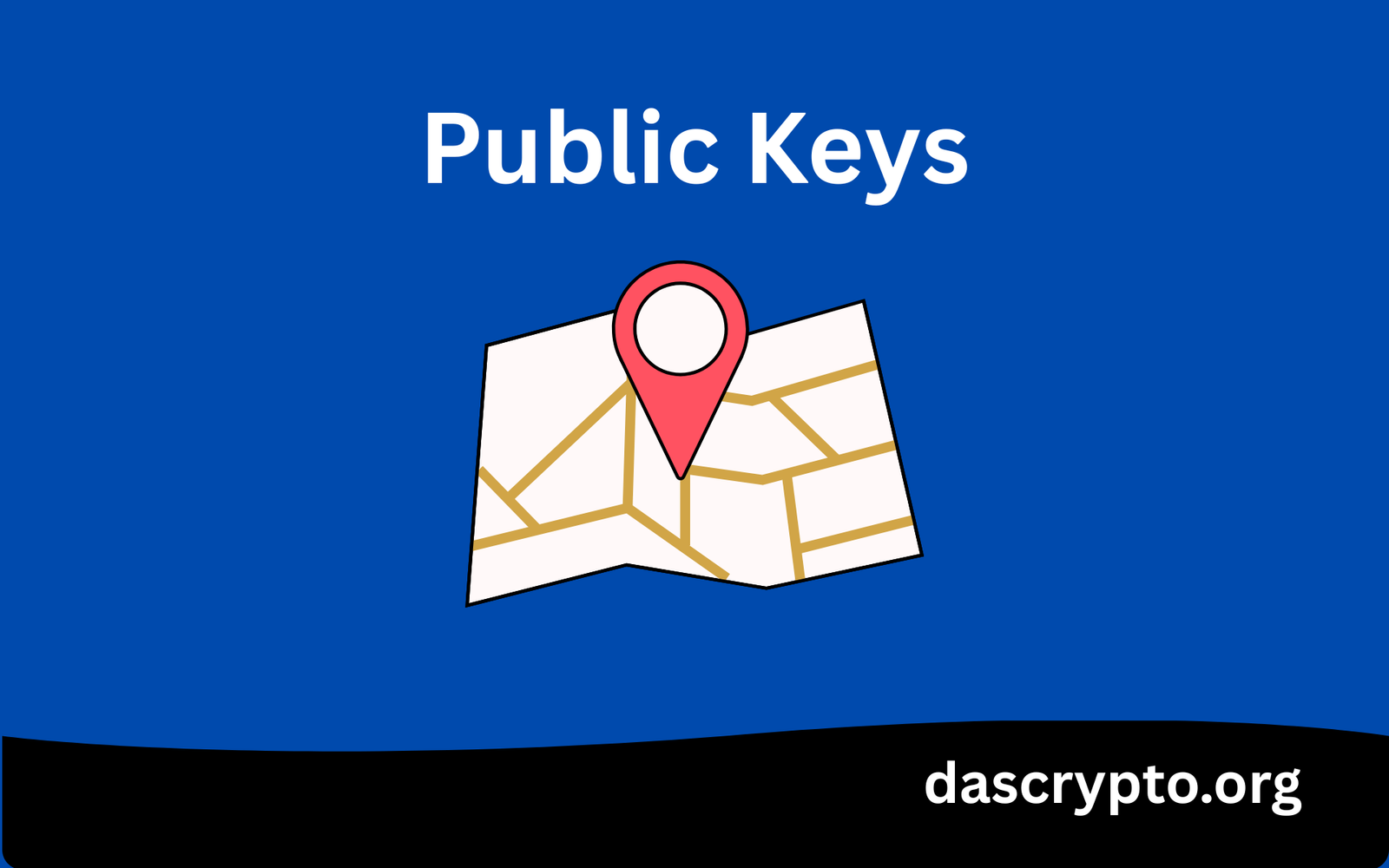
Public Keys are a series of alphanumeric characters and symbols used to generate blockchain addresses and private keys.
Public Keys are a series of alphanumeric characters and symbols used to generate blockchain addresses and private keys. Blockchain addresses can be shared to receive cryptocurrencies, while private keys are used to spend the cryptocurrency associated with that address.
Each blockchain has its own unique format of public keys, which helps users distinguish between the keys of two blockchains.
Public Keys are unique identifiers that help users distinguish between different Blockchain Addresses. Each address has its own unique public key.
Blockchains generate public keys (which act as passwords) by processing their private keys via a hash function. Such a function deletes some original data so that no public key can be used to recover its private key.
However, with quantum computing, private keys can be easily generated from their public keys. If that happens, any blockchain address can be easily drained using only its public key, which is already publicly available.
Imagine that you have a house, which has a specific location and a key that you can use to enter it. Blockchain Addresses are equivalent to a house; public keys are your address, which you can share with others, and private keys are the keys to your house.
For few addresses below, Hexadecimal means that public keys can only be created from alphabets ranging from a to f, and numbers ranging from 0 to 9. Hexadecimal is also called as Base 16 because it has 16 characters.
Similarly, Base 32, Base 64, etc use different numbers of letters, numbers and symbols as denoted by their suffix.
bc1qar0srrr7xfkvy5l643lydnw9re59gtzzwf5mdq0x742d35Cc6634C0532925a3b844Bc454e4438f44e0x04bfcab0e0c8a1b4a9e7f4d9b8127e3d8ce79f6e76f7db1b62a7b2e36a1ce06b0a245b2f6f93e4ed0b8f70a65b13e0f0b55b2f606cdb9cb51d5d4b2a8f40e2e2d39xQeWvG816bUx9EPzKDyZLrLqC1L1eLwW4jU7v9z3g7S03AB45E7B92A2F7C9D6E2F3C1B5D8E6A9C7D8B3E1A5C2D9F7A4B5C1E8F3A7B9D2F0x5b3e7a9e8c3a11e4c6b42c9c6eaf9b07bfc24a6e2e34f02f3b7cb8fbc3c02a1f0x7e1c3d8b42a67f3f91c9a4f2d8b9c5a3b2d4e7f8a9c6e5f1d2c8b4a7e3d9f6c4k+uLQy9D4LQv8k6byYd3Xn8M4iY7z1HqJb4zL0Y4oKk=V4QY5FZK7M3BOK6J5ZJ3A3K2YJZGXUGJYFJ4XABP7JBG4W37XK6PKUQJ7MNo, Satoshi Nakamoto did not create private and public keys. The mathematics and logic behind that concept existed long before Bitcoin, tracing back their origin to the mid-80s when first digital currencies started appearing.