Physical Address
304 North Cardinal St.
Dorchester Center, MA 02124
Physical Address
304 North Cardinal St.
Dorchester Center, MA 02124
Reasons for selling at a loss include emotional decisions, trading strategies, and shift in market fundamentals.
All investors and traders aim to generate profits from their crypto investments and trades. However, a few of them still sell at a loss despite long-term bullishness in the crypto markets.
In this article, we will examine the strategies, rules, beliefs, reasoning, and disciplinary attitudes that enable people to sell their cryptocurrencies at a loss, despite these assets being in a long-term bullish trend.
Traders and investors rely on various strategies that they have refined over time to optimize their investments. Below are a few such strategies.
Traders and investors typically maintain a stoploss at a predetermined price. The stoploss is a level below which the trade or investment is likely to generate further losses. These levels are decided on the basis of support levels, RSI levels, MACD crossovers, Bollinger Bands, etc.
Trend breakdown indicates that a certain bullish trend has either become mild, i.e., it will yield a lower rate of return, or even result in a loss. Trend breakdown is identified by indicators such as a sharp turn in the RSI, a negative crossover in the MACD, etc.
The image below shows such a breakdown where the sharp fall in RSI corresponds to a sharp fall in the price of Ethereum.
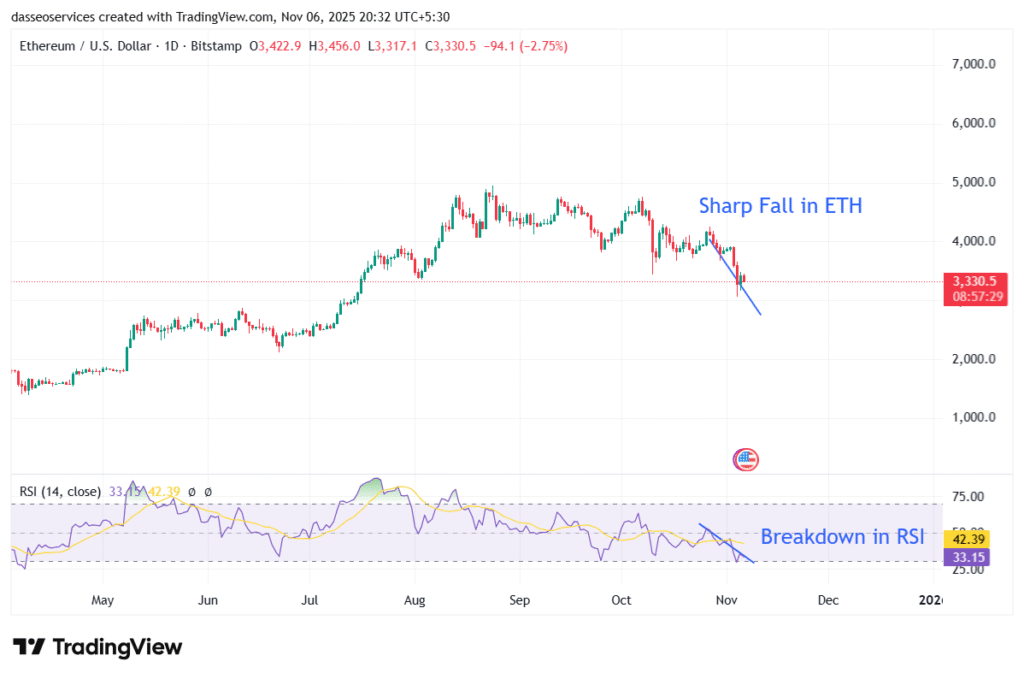
Some trading indicators, such as MACD, RSI, and Bollinger Bands, indicate a shift in trend from positive to negative. This is different than the trend breakdown discussed above. In the negative trend, the trade is expected to incur further losses, rather than reduced profits, in the trend breakdown. As a result, investors and traders are forced to sell despite a loss.
Many traders rely on fundamental shifts in the markets, such as positive or negative news, shifting macroeconomic trends (interest rates, inflation, tariffs, etc.), to make investment decisions. If a trader/investor expects that any of these financial indicators could turn or have turned negative, they may sell their assets, even if it results in a loss.
Emotions are the worst enemy of traders. In my 10 years of trading experience, the largest losses were mostly due to emotional decisions taken without due diligence and research.
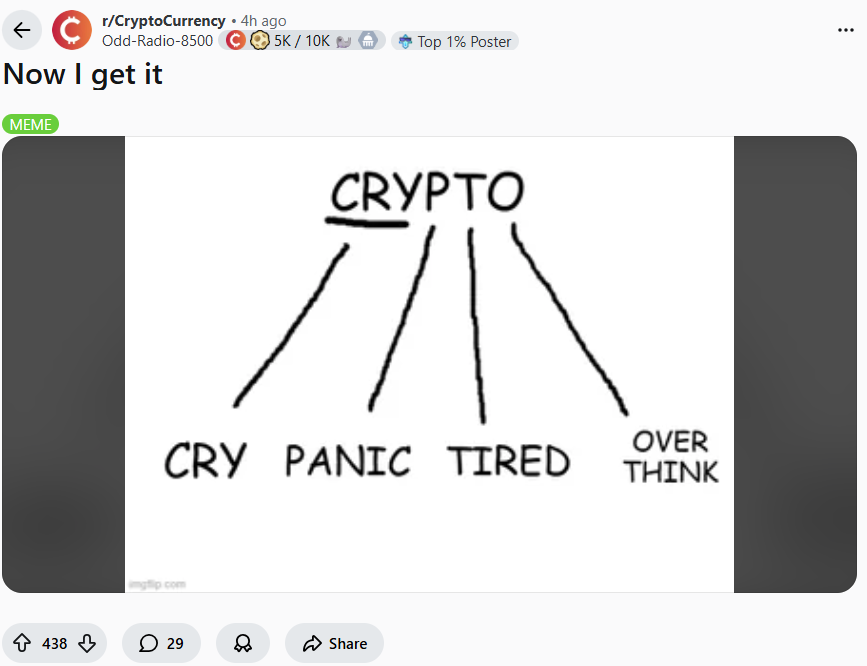
Several traders give in to market phobias, fear psychosis, peer pressure, FUD, etc., and sell their assets at a loss.
The discussion below is an example of such emotionally charged situations. Note that the original poster (OP) tries to inculcate doubt about the success of the crypto market as a whole in the minds of the users, which is then supported by over 400 viewers who have upvoted the post.
Das Crypto publishes information for knowledge. Please consult your financial advisor before trading or making any investment decisions. Cryptocurrencies are subject to uncertainties and market volatility.


